How are representations and discussions of space undertaken in the public sphere?
The public sphere is described by Jurgen Habermas as a realm of our social life in which something approaching public opinion can be formed. This space is free of power and equally available to everyone (Habermas, 1964). I have always been fascinated by space and have always blindly accepted that the news we see of space is exactly accurate and true depiction of what is happening. However, the public sphere is not a coffee house anymore but a world wide 24/7 network of communication. We also have news channels that deliver information to the whole world in seconds. As university students, we shouldn’t just blindly accept news that is altered to give us the information big businesses think we should know. That is why conspiracy theories are so big these days and the particular one I’ll be exploring is the moon landing hoax.
Because the universe is bigger than the average person can wrap their head around, many things in space are a representation of something that is god-like. In particular, the conspiracy theory that man never landed on the moon is an example of discussions and representations of space undertaken in the public sphere.
There have been people such as Joe Rogan and Shane Dawson that publicly speak out naming it a ‘hoax’. Regardless of this being true or not, the fact that this is such a popular conspiracy theory comes to show the lack of trust that the general public has when it comes to trusting big corporations with information they provide to us. This topic explores the relationship of powerful corporations and the general public in the sharing of information. Furthermore, it highlights that the public is an active audience and we don’t just blindly accept information but through conversations and denotations, we formulate our own opinions based on our ideologies.
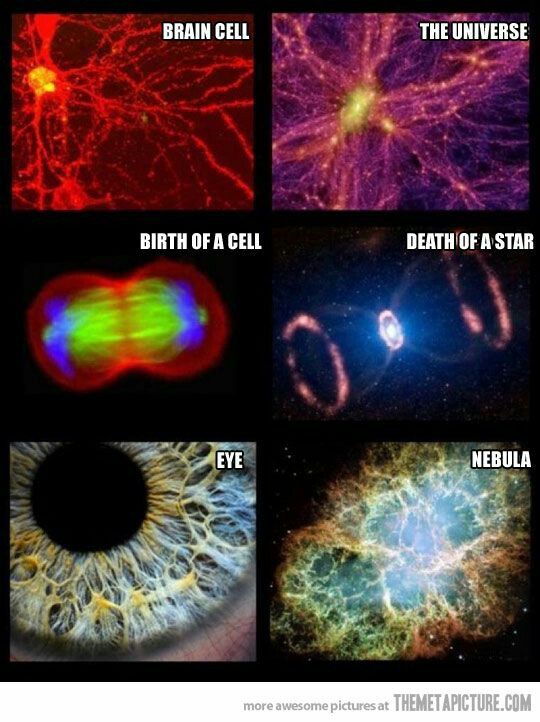
The reason why this topic is important is because space can be seen to have a god-like nature. So many things can not be explained by the science known to us. It is also fascinating how the universe and images in space are so interconnected with our bodies. For example, supernova’s (the collision of two stars), is the only way that iron could be produced in the universe. Iron is at the core of the chemical that keeps our hearts beating (Chi, 2016). It is also said that atoms are like solar systems, the large scale structure of the Universe are like neurons in a human brain, and there’s the interesting coincidence that the number of stars in a galaxy, galaxies in the Universe, atoms in a cell, and cells in a living being are all approximately the same large (10^11 to 10^14) number (Siegal, 2016). This shows how interconnected we are with space therefore further proving its relevance and importance. The reason why the images that we see of space is important is because it undeniably should be a focus, because in a way it’s understanding the world around us. As a student of communications, the purpose behind what is being communicated should be established. The content of the images that we see are important because as science evolves, so will religion to align with it.
So upon establishing the relevance of having a discussion about space, the main media case study I will address is the conspiracy theory that we never landed on the moon. Regardless of if this is true or not, it is a well known example of the public sphere discussing and challenging the media. This group of people have even been given a name along with anti vaxxers, flat earthers and holocaust deniers, they are called moon landing deniers.
A person that addresses this is Joe Rogan, a youtube personality podcaster. Joe Rogan like many other internet famous people have an undeniable huge audience, especially to younger generations. The audience of youtube can be described as a public sphere, a platform for shared idea’s and conversation. Rogan interestingly uses his platform to drive conversations in the public sphere that are of interest to everybody.
Because of modern day media ownership being heavily owned by right wing industries, places such as youtube is where young people go to educate themselves on the world. However, this also brings an opportunity for misinformation and false ideologies. Although it is important to be conscious about what we’re taught, many conspiracy theory followers have a reputation for being over imaginative and a bit far fetched. Crowds have been described by Gustav Lebon to have big imaginations in the public sphere. Crowds’ metaphorical imagination is extremely powerful, lively, and vulnerable to being deeply impressed. A person, an incident, or an accident conjures up images in their minds that are almost as real as reality. Crowds are similar to a sleeper whose reason has been suspended for the time being, allowing visions to excite in their minds (Lebon, 1896). Although this article is outdated, human being’s crowd mentality still seems to stay relevant. People use conspiracy theories to create imaginative realities and create communities in the public sphere to have discussions about this, such as the moon landing being a hoax.
Rogan talks about a number of reasons why he was convinced the moon landing didn’t happen and now is on the fence. He talks about how the U.S gave a piece of moon rock to the prime minister of Holland in 1970 as a gift, years later they analyzed the piece of rock and it turned out to be just a petrified piece of wood. He also talks about how they used an image from one of the astronauts training and blacked out the background to claim that this photo was taken on a space walk.

This however after further research proved false. This photo was never fabricated to be a photo from Michael Collins spacewalk but was, as described by Rogan just a photo from the previous training exercise. Collins’ book (the Farrar, Straus & Giroux 1974 version and the Ballantine Books 1975 edition) does not mention the photo being taken during the Gemini 10 spacewalk. The caption plainly reveals that the photo was taken during flight training. This shows that within the public sphere, people are allowed to share opinions and ideas that might be misinformation with little responsibility to be relaying the factual information sometimes.
Habermas explores the idea that mediated political debates and discussions are highly of value.Habermas say’s commercially produced cultural and political debates indicate a shift away from private people debating matters as a public of equals, as ‘human beings’. This means, our opinions align with what people in the media script for us, rather than learning about politics from our own everyday experiences (Balfour, 2004). The media act as a communication channel between politics and the general public, therefore the media is meant to represent the people. However, due to the unbalanced ownership of media favoring one ideology it can be destructive in educating the public.
This is relevant because this uncovers the power relationships between people in power and the general public. People such as Rupert Murdoch have a huge amount of news ownership. This unfortunately leads to the information being shared favoring of one ideology over another. Furthermore, this is spreading a biased ideology which means; Who can we really believe? And can we actually trust the information we receive from an industry that is meant to represent us, or is the information we receive all just what one old white man wants us to know.
Regardless of if the moon landing hoax is true or not, so many people believe in conspiracy theories because they don’t trust the media for this very reason.
Rogan speaks about a segment in Bill Clinton’s book which he said, once a carpenter told him that the moon landing was fake, and that after serving his term of presidency he wouldn’t be surprised if that were true. This although a vague comment, goes to show that it is known among people in powerful positions such as politics, that the public sphere is something that is able to be controlled and manipulated.
I don’t know whether or not the moon landing was a hoax, or if the information being communicated to us is accurate. The whole point of the conversation is to address the trustworthy nature of the information we receive from a media industry that is predominantly owned by one man.
Reference list
Balfour, T. (2005). Habermas’s Public Sphere : Politics and Australian News Media. https://ro.ecu.edu.au/
theses_hons/1000
Habermas, J., Lennox, S. and Lennox, F., 1974. The Public Sphere: An Encyclopedia Article (1964). New German Critique, (3), p.49.
Lebon, G., 1897. The Crowd: A Study of the Popular Mind. Psychological Review, 4(3), pp.313-316.
Youtube.com. 2021. Everything is Connected — Here’s How: | Tom Chi | TEDxTaipei. [online] Available at: <https://www.youtube.com/watch?v=rPh3c8Sa37M&t=322s> [Accessed 6 June 2021].
 Hannah Ward